Revisiting “The Sphinx” by Graham Masterton, the same author that gave us the cult classic paperbacks “The Manitou” and “The Djinn!”
Early Graham Masterton horror novels turned up around the same time at the Waldenbooks I frequented as a kid. Pinnacle was doing a push for U.S. paperback editions with a blurb promising an upcoming movie version of The Manitou. The Manitou was on the rack, of course, and The Djinn, a follow-up adventure for Masterton’s fortune teller hero Harry Erskine. The three suggestion maybe an author worth checking out. I’m not sure why I was drawn to pick up The Sphinx first. It was the third in publication order, though that was in the fine print.
Maybe it was the color combination and the artwork mix. The lettering was a striking teal. The step-back cover was fashioned just slightly narrower on the outer page so that you’d flip to the full collage on the inner page. Despite the steamy content, I don’t recall that being the selling point.
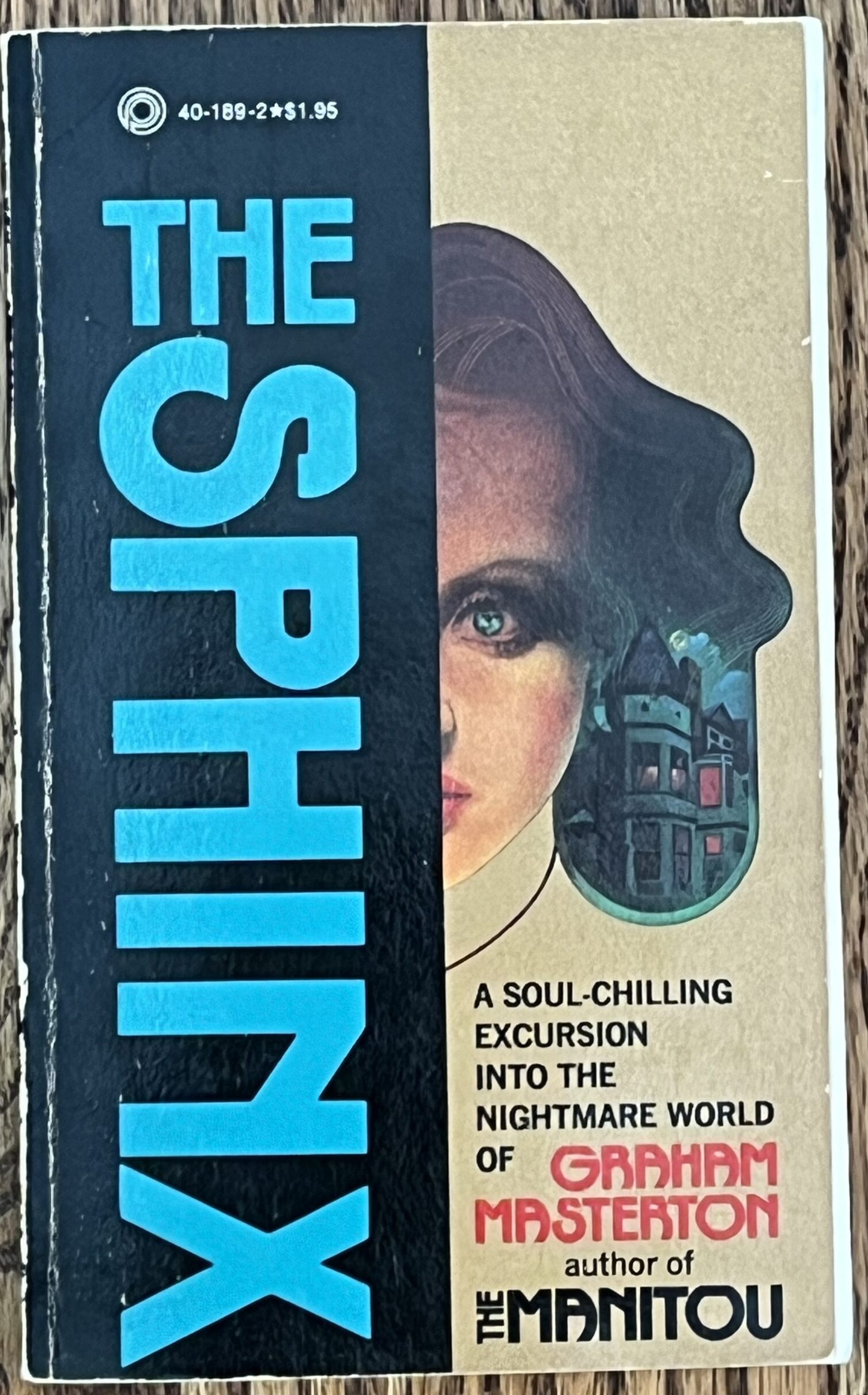

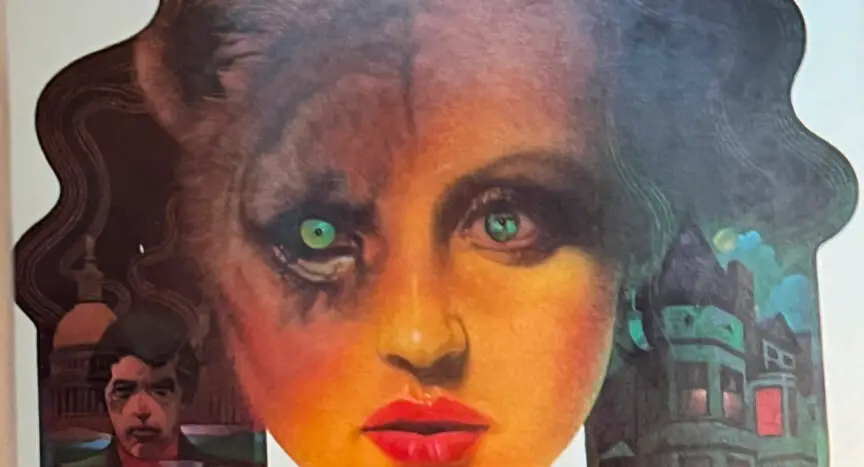
It was probably that cover. The internal cover of The Sphinx featured a full rendering of the collage-mix from the green-eyed title character, fully human on one side with a fading-in hint of a big cat as well as as an image of the novel’s protagonist and a gothic-looking mansion incorporated into the flowing locks.
Maybe the text under it caught my attention too, hinting a bit at the steam.
She was a woman no man could forget,
especially the one man who discovered
her terrible secret…
Surprisingly, none of that gave too much away, like a film trailer, it was forgotten as I was drawn into the story following its arresting first line: “He could always remember the first time he caught sight of her. Later, he used to joke about it and call it “Love at first bite.’”
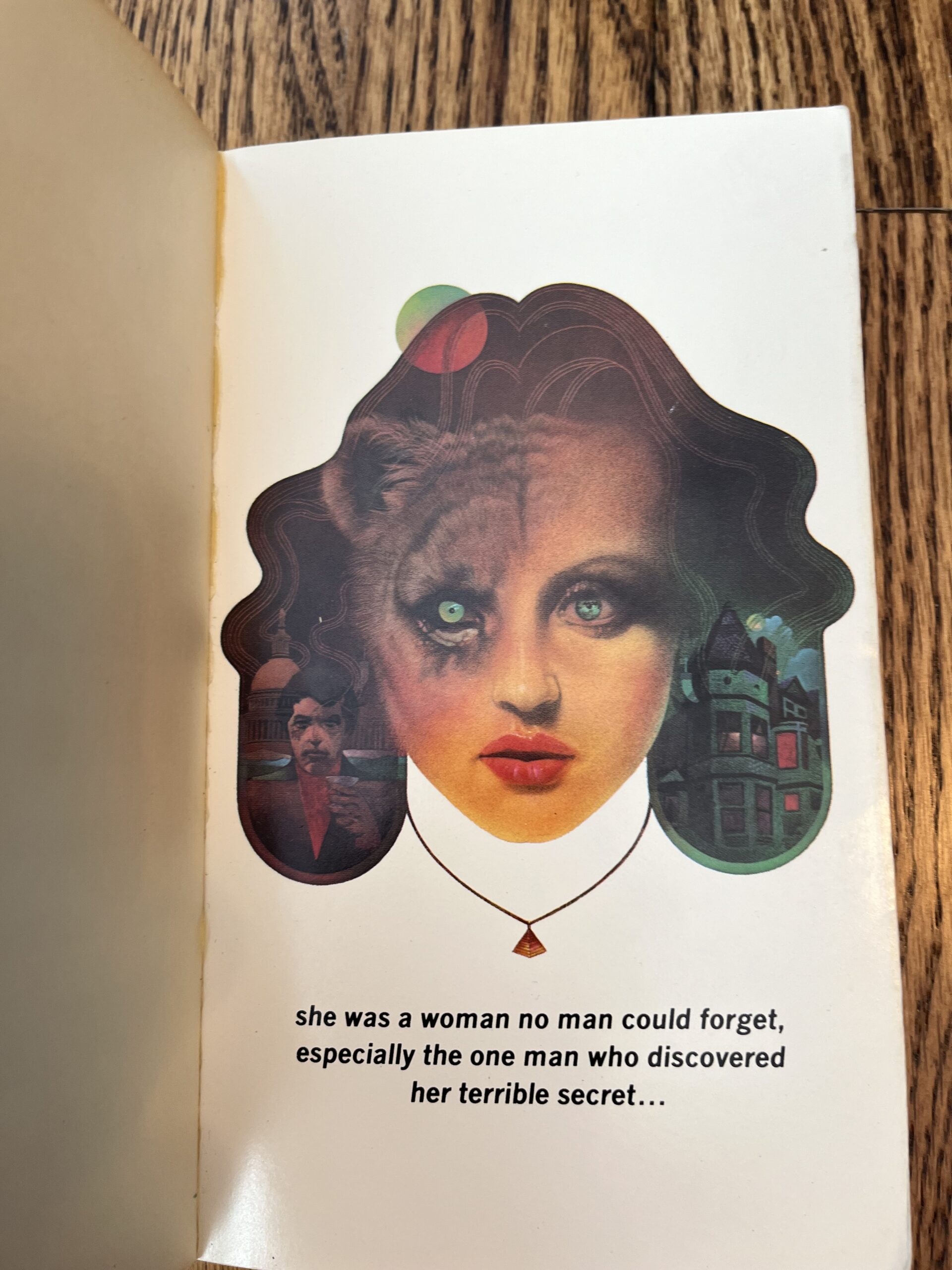
That first meeting of U.S. State Department officer Gene Keiller and the beautiful Lorie Semple is at a party in Washington, D.C. When Lorie enters, the crowd parts “like the Red Sea” and Gene’s captivated as the striking, 5 foot, 11 1/2 inch Lorie moves across the room.
She’s of Egyptian heritage and somewhat distant at first, even suggesting they remain strangers. Gene’s surprised to learn she’s attending because her father was actually the one with the invite. He has just passed away and attending is a way of celebrating his life. Family tradition. One of many strange ones.
Gene and Lorie end the night with a kiss that results in the aforementioned bite, she closes her teeth on his tongue to a point of drawing blood.
Despite all the strangeness, as that first line suggests, Gene becomes a bit obsessed, perhaps overly so and is soon in full ‘70s-style pursuit, delving into Lori’s life and family history and ultimately deciding he needs to “sneak over the wall of the Semple estate and check the place out.”
While he’s on the roof, something that’s not a dog snarls at him and ultimately makes a massive leaps up to his position to tear into him.
He awakes to find Lori, claiming she had had nursing training in Egypt, has ministered his wounds instead of calling an ambulance and the cops.
Warning signs are there for the reader and the protagonist, but Gene and Lori ultimately marry and he continues to unlock family secrets, not just about their strange manners. There’s more to Lori’s cat-like qualities than he could have imagined, even when discovering rows of superfluous nipples beneath her breasts.
The very nature of the Ubasti blends myth and science and delivers a page-turning experience that channels a bit of the title and maybe a few memories of Val Lewton’s Cat People.
The book’s maybe a little akin to Whitley Streiber’s The Wolfen, released the same year. I’ve probably spoiled too much already, but the novel’s been around a while. You had your chance, but it’s still worth a look and still delivers some surprises.
I have strong memories of reading the book on the school bus on afternoon travels home from early high school, and the story of the book continues for me long after that early reading.
I read many more Masterton novels in short order including The Manitou and The Djinn, and I probably learned a great deal in that process on the way to my first novel.
I wouldn’t have thought of sending a copy to Masterton in England if it hadn’t been for meeting C. Dean Andersson at a convention. Under his own name and his pseudonym Dean contributed many titles to the Paperbacks from Hell era including Raw Pain Max and later I Am Dracula, and when we served on a panel together, he mentioned Masterton’s Feast.
That got us talking about other Masterton titles, and Dean mentioned he’d sent the author a copy of one of his books.
“I should do that too,” I thought, realizing I should drop a note about his being an “influence.”
I never expected anything, but he sent me back a kind letter and a blurb: “Sidney Williams has the ability to conjure the genuine reek of hell.” That was a thrill. It made its way onto a blurb page in my last novel under my name from Pinnacle.
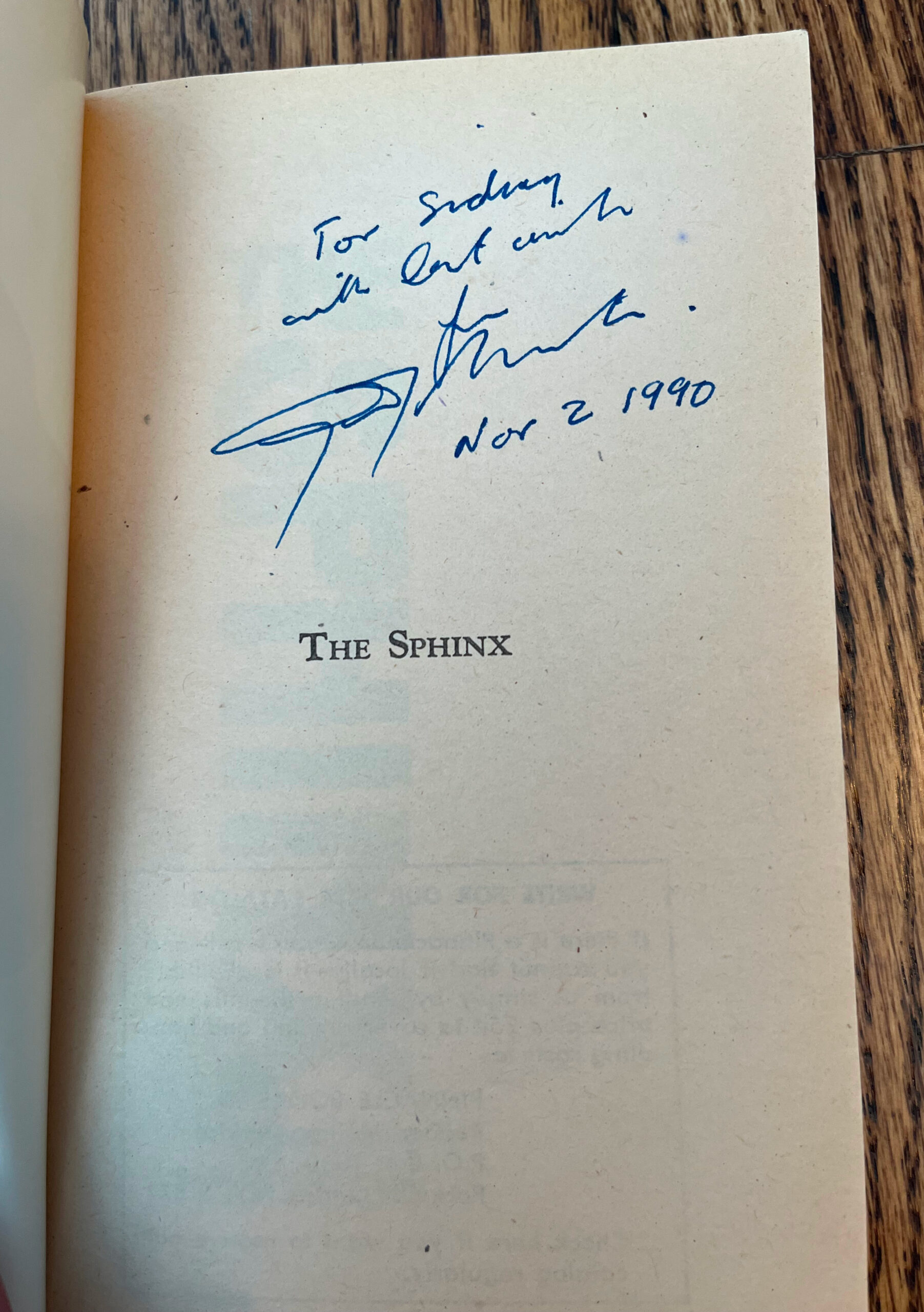
A while after that and more than 20 years after the first reading, I saw Graham Masterton would be in the U.S. for a World Fantasy Convention I’d be attending near Chicago. Fortunately, I still had my copy of The Sphinx. I tucked it in my suitcase.
And I bumped into him in a hallway. He was wearing a suit, very much an English gentleman, very pleasant and cordial.
I gave him a quick refresher on who I was and even quicker had that paperback in hand to get it signed and complete the circle of The Sphinx.