Articles, books and documentaries have dissected Alfred Hitchcock’s Psycho and the shocking and terrifying shower scene. It stunned audiences in 1960 and still surprises some uninitiated viewers today. It’s perhaps the best known though far from the only arresting moment from Hitchcock.
The director had earned accolades and recognition as The Master of Suspense long before. While Psycho was certainly a pinnacle, many of his films included stunning, often in-tight set pieces that put viewers on edge.
At times, these are truly nail-biting moments as the audience lives through intense experiences with the characters. Here are a few gripping scenes from films, some renowned in their day, that don’t get quite the notice and discussion afforded titles like Psycho, The Birds, or North by Northwest.
Shadow of a Doubt (1943)
The tense life-or-death struggle in this slow-burn mystery is shorter than set-pieces Hitchcock would conjure later. But as the punctuation point for a film of building dread, it scores. The showdown between the picture’s two Charlies anticipates more intense thrills to come from The Master. Charlie Newton (Teresa Wright), a bored young woman living with family in the suburbs, sees her world upset with the arrival of her Uncle Charlie Oakley. A string of murders seems to stretch behind him. Young Charlie becomes suspicious and anxiety builds to a confrontation in the open door of a speeding train. Young Charlie’s gloved-hands fumble and clutch for something, anything to hold onto as her uncle peels her grip free and slowly presses to force her to her death. Do protagonists always win? Who’s going out that door?


See Also: Psycho II is Almost as Good as the Original, Here’s Why
Dial M for Murder (1954)
The early, actual dial-M scene of the title here stretches longer than Shadow’s moment of truth while playing a similar, up-close game. It also offers even more intercutting on incidental moments. The audience waits and wonders. Ray Milland’s Tony sits in a restaurant having arranged the death of his wife, Margot (Grace Kelly) in their apartment. He just needs to dial his home number to get her into place. Said number begins with six (coinciding with M on an antique rotary dial). Tony can’t get into the phone booth at first, seconds tick past, but then he does, and his finger fatefully aims for that M. The phone switching system’s triggered and viewed in technical detail, something later expanded in Bob Clark’s Black Christmas (1974). Margot’s awakened. As she groggily walks from her bedroom and takes the call, hired killer Anthony Dawson emerges from the shadows ready to strangle. The struggle’s not brief as Tony listens. Will Margot survive as a cloth’s wrapped around her neck? And where will the story go next?

See Also: Ten Horror Movies Marketed as Thrillers
The Man Who Knew Too Much (1956)
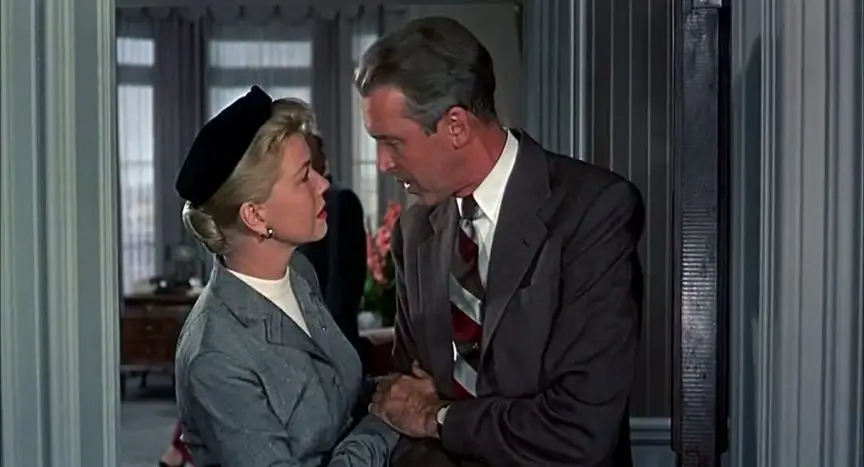
Hitchcock famously stated that a satchel with a bomb in it is exciting for only a few seconds. If you show the audience the bomb and have characters in the room unaware and talking, the suspense builds longer. The audience wonders when the bomb will go off. In this film, bearing the same title of an earlier Hitchcock film, that theory is in practice. Exposition prepares viewers for an assassination that will occur during a concert at Royal Albert Hall. James Stewart, as Dr. Ben McKenna, and Doris Day, as singer Josephine McKenna, need to stop it while their son’s life hangs in the balance. Hitchcock’s lens offers expansive views of the orchestra tuning up, skeletal and menacing assassin Reggie Nalder (‘Salem’s Lot) getting into place, Jo, then Ben arriving. Ben encounters police, tries to explain himself, then rushes from private box to private box, and the music builds, gets nearer and nearer to the critical point. The camera pans the sheet music, following the staves…will Ben and Jo be in time to stop a murder? The scene’s suspense is only equaled by the film’s final few minutes which famously uses Day’s performance of “Que Sera, Sera” for a tight edge-of-the-seat conclusion.
 Family Plot (1976)
Al Pacino wanted too much money, so for what turned out to be his final film, Hitchcock hired Bruce Dern as taxi-driver sidekick to phony psychic Barbara Harris. On the trail of a missing heir with a possibly hefty payout, they run afoul of glitzy crooks Karen Black and William Devane. When a car’s brake line is severed, the vehicle barrels through potentially deadly twists and turns with the shady heroes wide-eyed in terror. Sophisticated viewers will recognize intercut studio shots right away, but it doesn’t matter. The scene will have viewers holding their breath and maybe even closing their eyes as fiery, crashing death on a mountain road seems imminent.

Frenzy (1972)
The television ads for this one featured Hitchcock himself ordering neckties in a men’s shop and assuring the clerk he’s not particular about style. “They’re for a friend who uses them to strangle women.” Those familiar with his TV hosting turns would have recognized that dark whimsy. The film is a much more serious thriller about a down-on-his-luck man, Richard Blaney (Jon Finch), falsely suspected of a serial rapist/strangler’s work. Breanda (Barbara Leigh-Hunt), a woman he’s encountered, gets a visit from the killer (Barry Foster) at her office. The scene is a brutal mirror of the 45-second Psycho shower scene and Dial M’s mostintense moment as well. Frenzy’s frames capture each moment from the killer’s removal of his necktie to Brenda’s struggle and suffocation. It’s all unfurled in quick cuts and tight camera shots, but it’s not quick. Hitch is merciless here. It’s literally a breathtaking scene for victim and viewer that once seen won’t be forgotten.